A new Online Collections portal will launch on February 9th.
Object information on this site was last updated on January 15th, 2025 and will be static until then.
Search Results:Viewing Record 1 of 1 | |
| Maker(s): | Emerson, Peter Henry | | Culture: | British (1856 - 1936)
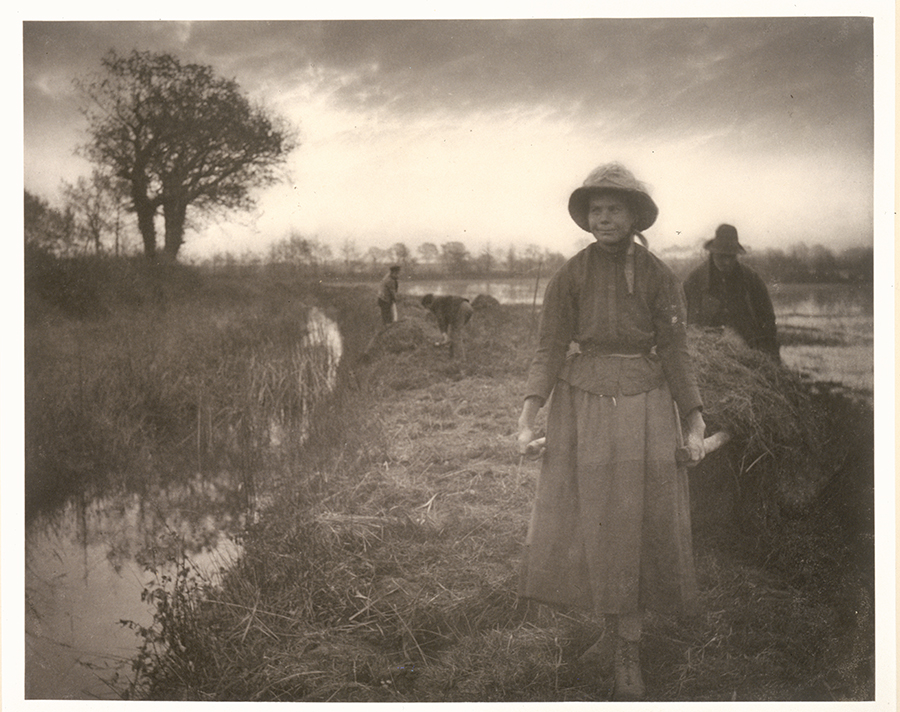
| | Title: | Poling the Marsh Hay, Plate XVII from "Life and Landscape on Norfolk Broads"
| | Date Made: | 1887-1888
| | Type: | Photograph
| | Materials: | platinum print on heavyweight off white wove paper
| | Place Made: | United Kingdom; England
| | Measurements: | sheet: 11 5/16 x 15 1/4 in.; 28.7338 x 38.735 cm; image: 9 1/16 x 11 3/8 in.; 23.0188 x 28.8925 cm
| | Accession Number: | SC 1995.3
| | Credit Line: | Purchased with the fund in honor of Charles Chetham
| | Museum Collection: | Smith College Museum of Art
|
|
|
Label Text:
Poling the Marsh Hay is one photograph from the series Life and Landscape on the Norfolk Broads, a seminal work in the history of photography. The Norfolk Broads were a network of freshwater lakes and rivers on the east coast of England. Wild, remote, and long protected from industrialization, the region rapidly transformed with the introduction of railway travel in the 1880s. As tourism and technology overthrew the old agrarian economy and way of life, Peter Henry Emerson sought to document with his camera what he saw as a disappearing world.
Influenced by Whistler’s art and aesthetics, Emerson believed that photography should spring from the direct observation of nature. Based on this principle, Emerson revolutionized photography with a movement known as Naturalism. While it was standard practice at the time for photographers to manipulate negatives in the darkroom in order to compose their images, Naturalism maintained that the photograph should show a one-to-one equivalent of what existed in front of the camera. To this end, Emerson developed techniques for attaining realistic effects with the camera itself.
One such technique, evident in Poling the Marsh Hay, is called differential focus. Like Whistler, Emerson subscribed to optical theories arguing that the human eye cannot focus on near and far objects simultaneously. Differential focus allowed Emerson to achieve a combination of sharp and soft focus effects within the same image, creating a naturalistic depiction of space as seen by the human eye.
Subjects:
exterior; Farmers; Trees; Water; Women Link to share this object record:
https://museums.fivecolleges.edu/detail.php?t=objects&type=ext&id_number=SC+1995.3 |
|
Research on objects in the collections, including provenance, is ongoing and may be incomplete. If you have additional information
or would like to learn more about a particular object, please email fc-museums-web@fivecolleges.edu.
|